
Find the one small thing you already know that's worth selling.
One payment. Instant access. A Notion page you copy plus a printable PDF.
From two coaches with more than 20 years each in People Analytics and enterprise sales.
Plus three free bonuses, included with your order.Scroll down to see them
By the end of one afternoon you can say what you'd sell: a shortlist of what you already know, each row matched to a format that fits the hours you have, with one row picked and dated. Nine short sections get you there, one thing to write in each, about two hours in all.
You already know what you'd sell. Nobody showed you where to look.
Somebody told you, probably two years ago, that you should sell something digital. You agreed. Then you looked into it, and every answer came from someone with fifty thousand followers and a podcast. So you saved a dozen links, opened Canva once, and closed it. There's a folder on your desktop with a half-written something in it. You haven't opened it in months.
Maybe you asked ChatGPT what digital product you should make and got ten ideas that could belong to anyone. Maybe you watched the free webinar, and it ended with a course that costs more than a month of your hours. Neither one knows what your coworkers ask you to explain twice, so neither one can point at the row you already have.
Here's what we've noticed. The people who know the most about a job are the last to believe it's worth anything outside that job. A nurse who built a shift handover sheet the whole ward uses. An electrician who's been asked for his quote template three times. A teacher whose lesson plans get borrowed every year. They call that "my job." A stranger on a marketplace would call it a product.
You're not unqualified. You're unpublished. Those are different problems, and only one of them takes an afternoon to fix.
The thing you'd sell isn't hiding. It's the thing a coworker asked you to explain twice. It's the sheet you made for yourself because nobody else had. You stopped noticing it years ago, which is exactly why it never made the list.
The Pick-Your-Format Guide exists to put it on the list. Not a business plan. A shortlist, the format each row fits, and one pick with a date next to it. Small enough to be wrong, which is the whole point.

Does this sound like your week?
- You've typed "what digital product should I make" into a search bar more than once, and closed the tab before the results loaded.
- Somebody asked you last month how you do the thing you do. You explained it for twenty minutes and thought nothing of it.
- There's a sheet on your work laptop you built for yourself. Two coworkers have copies. Nobody paid for it.
- You've got an hour on Sunday if it's a good week. Every video you've watched assumes free evenings and a following.
- The sentence that shows up right before you close the tab is some version of "who would buy this from me."
The problem isn't that you haven't looked. It's that every answer you found assumed a following, free evenings, and a whole course, and none of those are yours.
So it's tempting to keep saving links until the right one shows up. But another saved link doesn't put your sheet on a list. A year from now you could have the same job, the same folder, and a few more tabs closed, and "I don't know what I'd sell" would still be the honest answer.
You don't need a bigger idea, more followers, or a design skill. You need a short list of what you already know, and a way to pick one.
A Shortlist, with one row picked and dated
Before you build an audience, learn a tool, or save another link, write down the three to five things you already know and let one of them pick itself, so "I don't know what I'd sell" stops being true.
The Shortlist does the sorting for you. Three to five things you already know, each with who asks, what the buyer needs, the format that fits, and rough hours. One row has a checkmark and today's date next to it. The other rows are parked, on purpose, because they're your next products.
That table is the thing most people never write down. Once the small version is on paper with a date, the question changes from "what would I even sell" to "what does this one file need to be." That's a question you can answer on a Sunday.
It isn't a business plan or a tool recommendation. It's one pick, and it doesn't ask you to quit anything.
It also asks nothing you don't have. No audience, no website, no design skill, no free evenings. Every tool named on the page is free, and the pick is sized to an hour on a Sunday, which is why this one gets finished.
Here's how the Pick-Your-Format Guide works
Buy it and open the email
Your links arrive in a minute or two. Click Duplicate and the page copies into your own free Notion. Prefer paper? The PDF is attached at the top.
Work through nine short sections
Sunday at nine, kitchen table, Section 1 open: one sentence about what a finished pick should change for you, and the first one is done. Most take ten to fifteen minutes. Each one ends with one thing to write. Section 5 is the Shortlist itself, about twenty minutes. Stop there if you need to.
Answer two questions, then pick the fastest row
How many hours do you have this month, and does your buyer need to understand something, do something, or have something. The answers point at a format. Then check the row with the fewest hours, not the best idea, and date it.
Notice, along the way:
- By Section 3, four real candidates are on paper, none of them invented, and one is a sheet you made for yourself years ago.
- By Section 5, every row has a format and rough hours, and the fastest one is obvious before you check it.
- By Section 9, you can say in one line how far the pick is from the sentence you wrote at the start.
Everything inside the Pick-Your-Format Guide
Not a folder of information. One thing to finish, in nine short pieces.
What you want this to change
You decide what this is for before you look at a single format. One sentence about what a finished pick should change for you.
What's really stopping you
The doubt gets something to argue with besides you. The sentence you say right before you close the tab, written down next to a listing that already exists.
How small a sellable thing can be
An hour on a Sunday becomes enough. A checklist sells, a spreadsheet sells, and four real candidates go on paper, none of them invented.
A nurse who made something useful
You can say who's selling without the word business. One honest sentence: a role you already have, a thing you made, who it helps.
The two questions and the Shortlist
"What would I even sell" turns into a table you could read out loud. Hours this month, and understand, do, or have. Every row gets a format, and the table fills in.
Who you're becoming
You're not becoming an entrepreneur. You're becoming the person who finishes a list like this. One line, written before you pick.
Pick the fastest one
The comparing ends and the building can start. Check one box, write today's date, park the rest.
What the parked rows are
The second product is waiting when the first is done. The rows you didn't pick are your next two, and the first one points a buyer at the second.
Check the pick against your sentence
You know whether the pick serves your life or only sounds good. Read your sentence from Section 1, read your pick, and write one honest line about the distance.
Your own Notion copy
One click on the Duplicate icon and the page is yours, on the free plan, private to you. Every answer feeds a progress list at the bottom.
Printable PDF
The same nine sections and Shortlist table, laid out to print with ruled space to write. Attached at the top of the page.
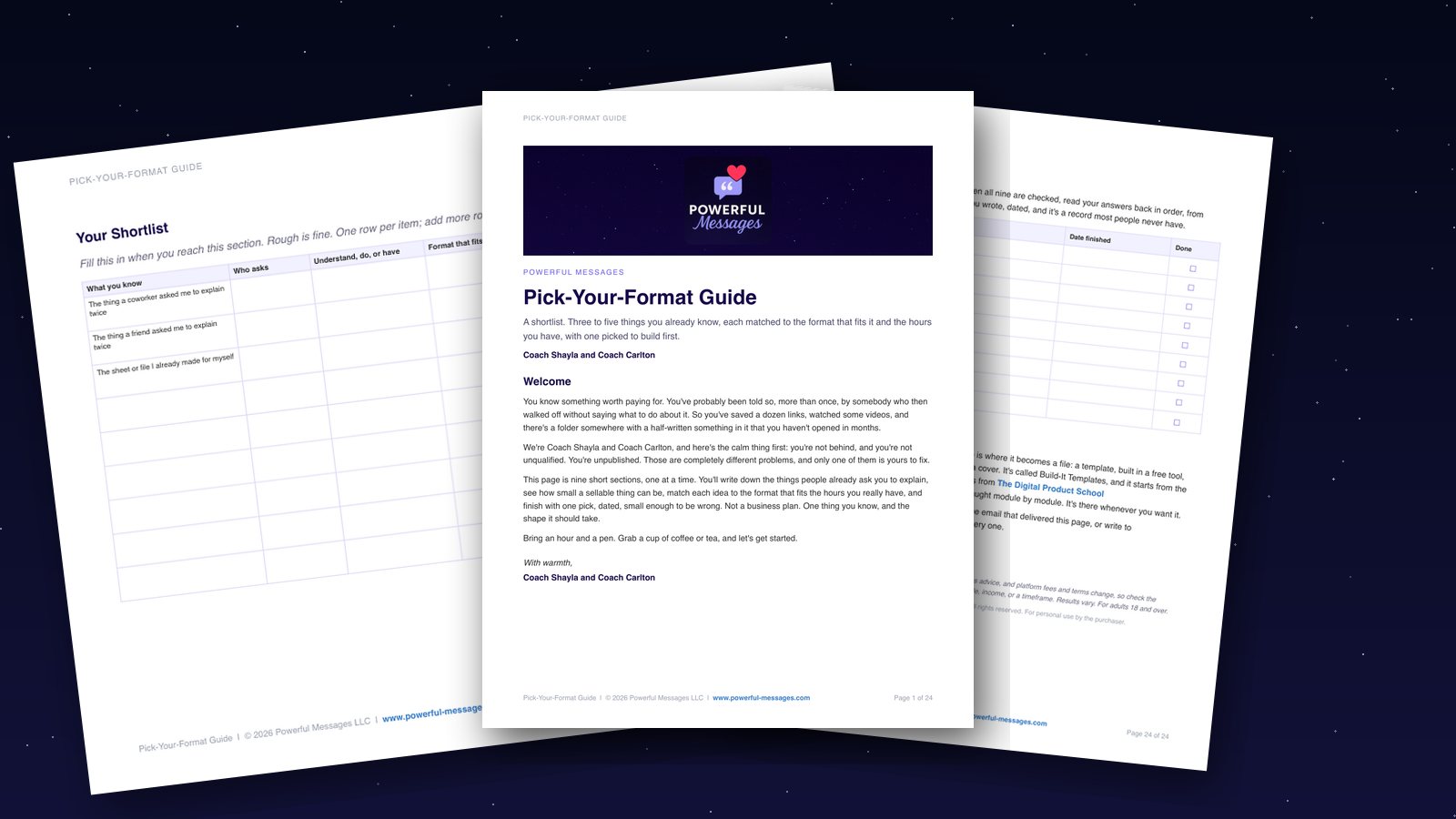
Take a look inside
Press play for a quick look inside.
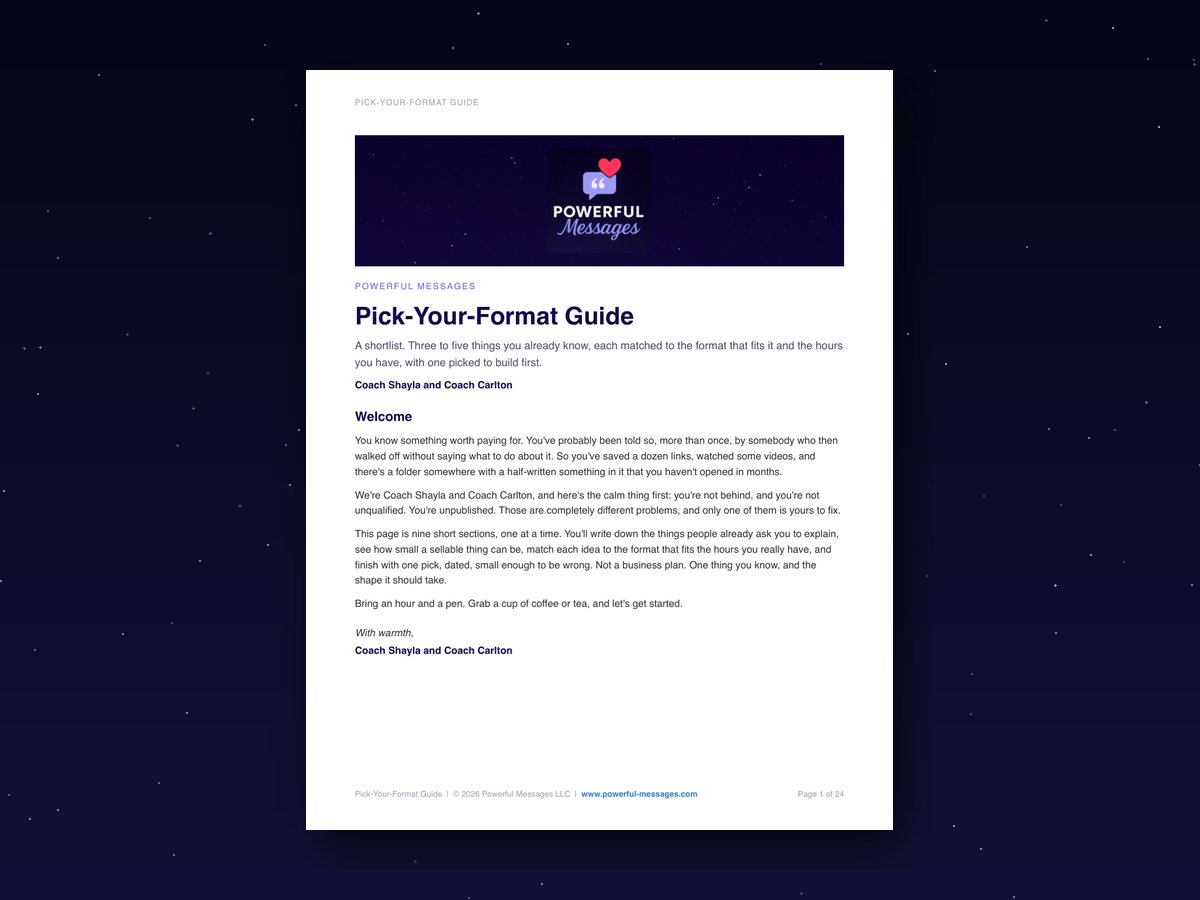
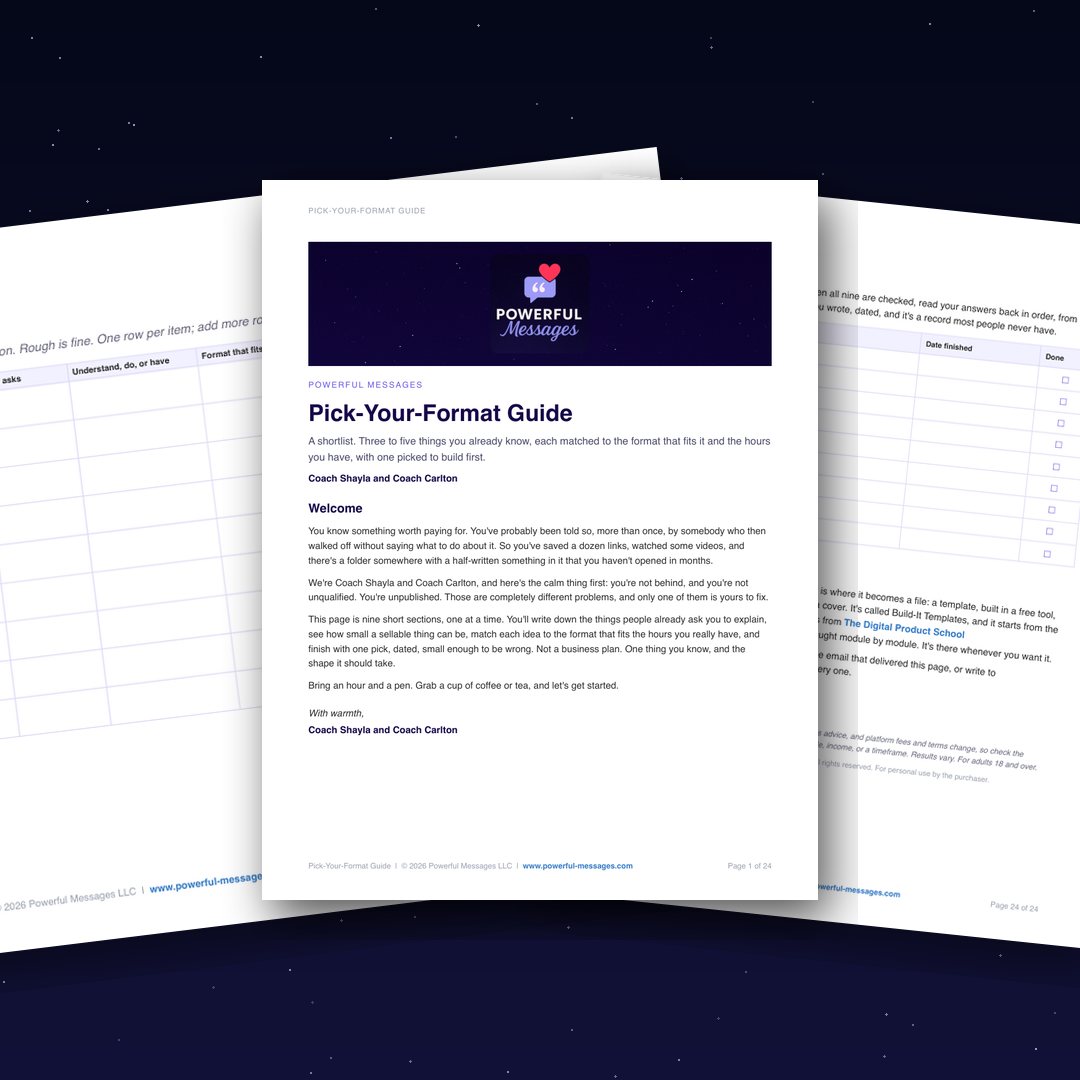
The cover and welcome page.
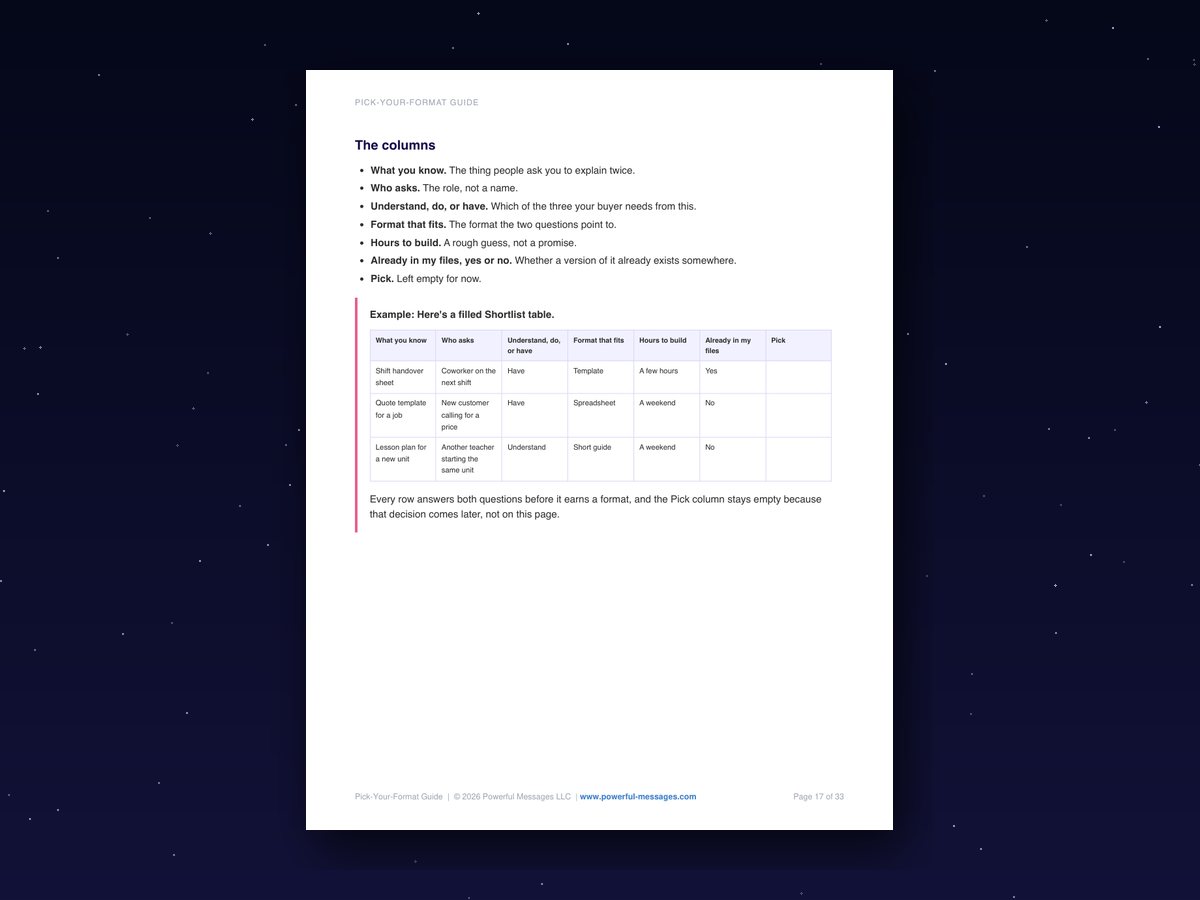
The Shortlist page. Seven columns, three starter rows, and a filled example above it.
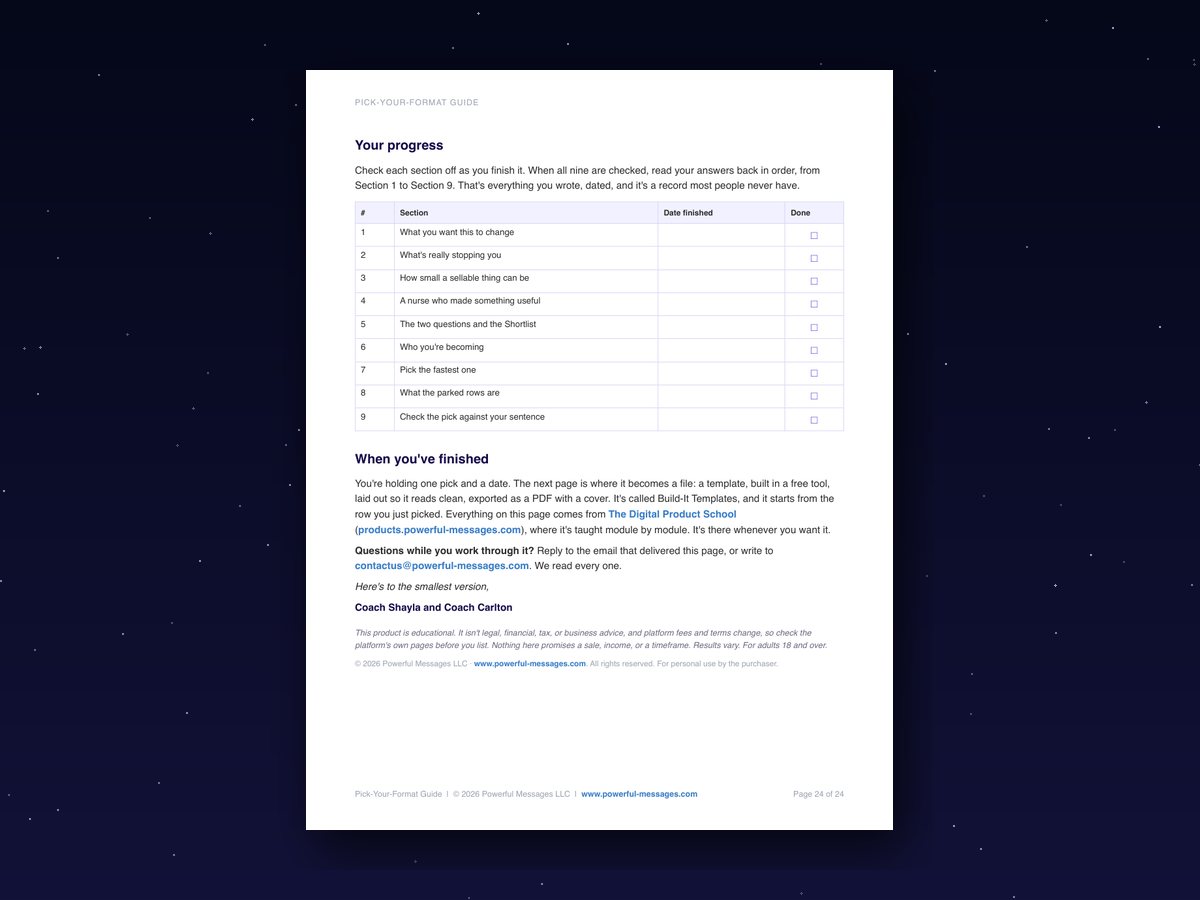
The progress list. Every answer, date, and Done box in one place.
Three free bonuses, so the page gets finished
If you've bought a guide like this before and never got past page two, these are for that. Each one is a page you keep next to the Pick-Your-Format Guide. They come in the same email, a minute or two after you order.
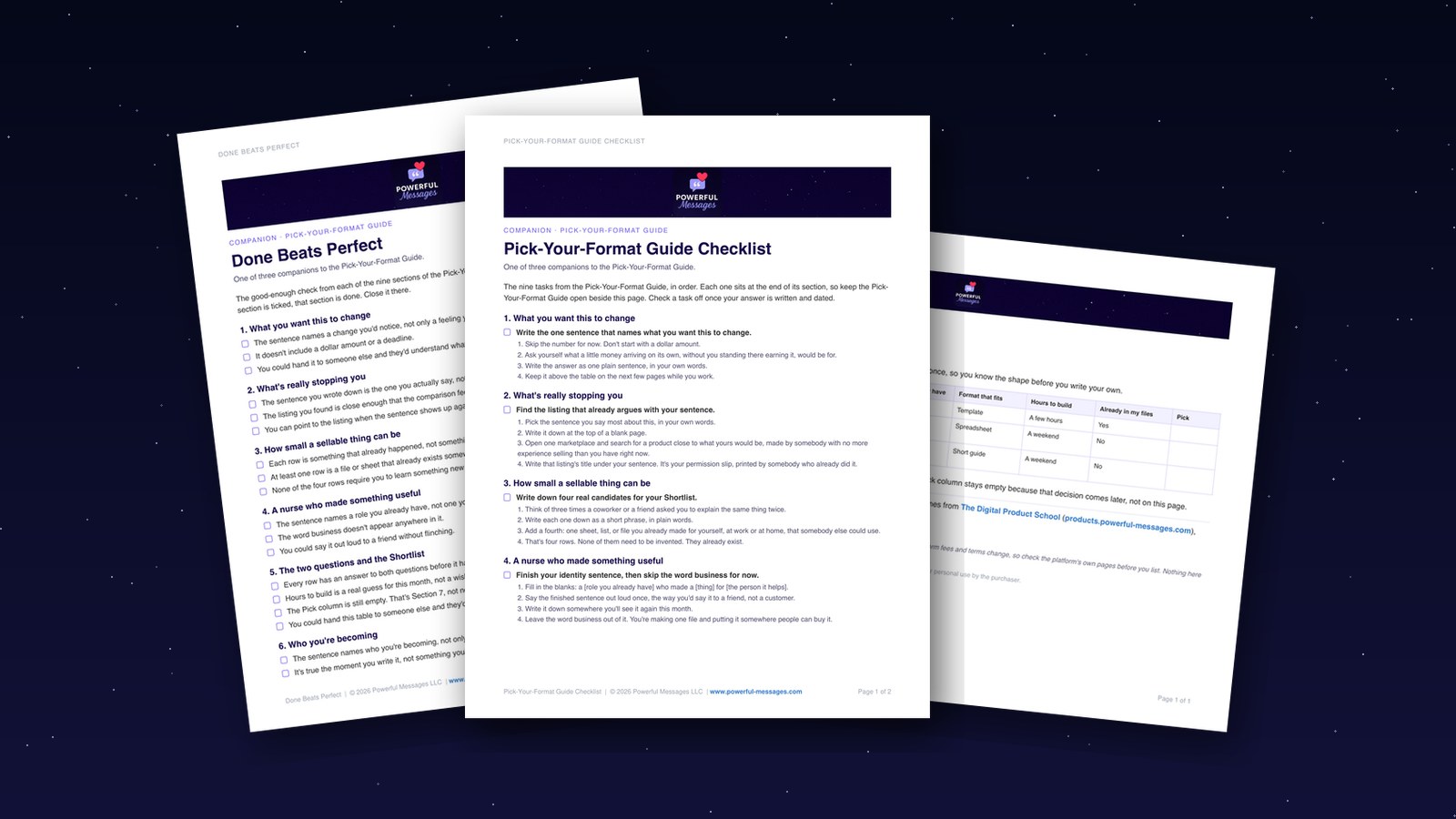
Pick-Your-Format Guide Checklist
The nine tasks from the Pick-Your-Format Guide, one per section, in order. Tick each one off once your answer is written and dated, so you always know where you stopped.
Filled Shortlist
The Shortlist from Section 5, filled in by the coaches. Read it once so you know the shape before you write your own.
Done Beats Perfect
A good-enough check for each of the nine sections. When every box is ticked, that section is done, and you can close it without a second edit.

What changes once it's on paper
- You can name what you'd sell in one sentence, so that "I don't even know" stops being the answer.
- Each row has a format matched to your real hours, so that you stop waiting for a month with more time in it.
- One row is picked and dated, so that the comparing ends and the building can start.
- The rest of the list is parked, not deleted, so that the second product is waiting when the first is done.
This was built for you if
- You've done a job, a trade, or a hobby well for years, and people keep asking you to explain the same things.
- You've been told to sell something digital, you agree, and you don't know what it would be.
- You've got no audience, no website, and no design skills, and you assumed that ruled you out.
- Your week is work, family, and an hour on Sunday if it's a good one.
- There's a folder with a half-written something in it you'd like to stop feeling bad about.
It isn't for you if
- You already have a product built and want help selling it. That's a later tool.
- You want a tool recommendation, a platform review, or a business plan.
- You want someone to pick for you. The Pick-Your-Format Guide asks two questions. You answer them.

Meet the coaches behind it
We're Coach Shayla and Coach Carlton, the husband-and-wife team behind Powerful Messages. After decades in Fortune 500 corporate America, we know what it's like to be handed something new and unclear with your name on it. Coach Shayla and Coach Carlton each bring more than 20 years in their fields, People Analytics and enterprise sales, and a practical way of building things that hold. We built the Pick-Your-Format Guide because the people who know a job best are usually the last to believe it's worth anything outside it.
Two options from here.
Keep closing the tab: another year of "who would buy this from me," another folder nobody opens.
Or write down what you already know, match each row to the hours you have, and check the fastest one. One afternoon. One shortlist. One pick with a date next to it.
One shortlist. One pick. One date. About two hours.
One payment. Yours to keep.
Get the Pick-Your-Format Guide for $17$27 on its own · you save $10Get the Pick-Your-Format Guide for $17
Your name, your email, and your card. Your links arrive by email a minute or two after you pay.
Everything you get today
- Pick-Your-Format Guide the shortlist of what you already know, one row picked and dated (Notion page plus printable PDF)$27
- Free bonus: Pick-Your-Format Guide Checklist the nine tasks, one per section, to tick off as you go$19
- Free bonus: Filled Shortlist the coaches' worked example, so you know the shape before you write yours$19
- Free bonus: Done Beats Perfect when to call each section done and stop editing$19
| Total value | |
| Today | $17 |
One payment, no subscription. Instant access after payment.
I agree to the Terms and Privacy Policy, and to calls and texts about my order. Msg and data rates may apply. Reply STOP to opt out.
Questions people ask
I've bought things like this before and never finished them.
Most of those were courses. This is a table. Nine short sections, one thing to write at the end of each, and a planned stopping point after Section 5. Stop there and you're already holding the Shortlist.
Is two hours enough?
About two hours in all, and it doesn't have to be one sitting. Most sections take ten to fifteen minutes. The Shortlist in Section 5 takes about twenty. Stop there if you need to. Everything you've written is saved.
I'm not techy. Do I need to know Notion?
No. You click one icon, Duplicate, and the page copies into your own free Notion. Then you type where it says to type. Or skip Notion and use the PDF at the top of the page, same sections, ruled space to write.
What if I don't know what I'd sell?
That's who the Pick-Your-Format Guide is for. You won't invent anything. Section 3 starts from three things somebody asked you to explain twice, and one sheet you already made for yourself. Those are the candidates.
What if everything I know is already being sold?
Then somebody's already proven people buy it. Section 2 sends you to find one listing close to yours, made by someone with no more selling experience than you have. That listing is your permission slip.
How long do I have access?
It's yours to keep. The Notion page copies into your own workspace, and the PDF is a file you download. Nothing expires.
Can I get a refund?
Yes. Work through it. If it isn't for you, email us within seven days for a full refund.
What happens after I buy?
You'll get an email from Powerful Messages with your links in a minute or two. Open the Notion page, click Duplicate, and start at Section 1.
Next Sunday night, around nine
Same desk. Same folder. This time you open it and there's a table on the page above the half-written thing, with one row checked and a date beside it. You know what it is. You know it's small enough to build in the hours you have, and the other rows are waiting their turn.
Nothing about your job changed. What changed is that "I don't know what I'd sell" isn't true anymore, and you could say so out loud.
You know what you'd sell now. It's on the list.

One afternoon. One shortlist. One row picked and dated.