
Decide what you want to be known for. One sentence, one sitting.
One payment. Instant access. A Notion page you copy plus a printable PDF.
From two coaches with more than 20 years each in People Analytics and enterprise sales.
Plus three free bonuses, included with your order.Scroll down to see them
By the end of one sitting you're holding the sentence every post starts from: who you want to find you, what for, and the belief underneath it, with a date on it. Nine short sections get you there, one thing to write in each, about two hours at your own desk. No camera, no posting schedule.
You already know what you'd say. You haven't decided what you're for.
It's a Sunday night. You open your profile to check one thing and the last post is from months ago. You close it before you finish reading it. Somewhere in your notes app there's a draft you've started three times.
Maybe you asked ChatGPT for thirty post ideas and got thirty that could be anyone's. Maybe you bought the hook templates, and the posts came out sounding like the person who sold them. Neither one knows what you believe that someone in your field would argue with, so neither one can say what you're for.
The people who've hired you know you're good. The people who haven't yet can't tell from your profile, because nothing on it says what you're the one to ask about.
You've told yourself it's time. You had the same time in the two weeks you did post. You've told yourself it's ideas. Your notes app is full of them.
We're Coach Shayla and Coach Carlton, and after a lot of years watching capable people go quiet online, here's what we've noticed. The blank page isn't an idea problem. It's a decision you never made about what you want to be known for, and until it's made, every post starts from nothing and lands nowhere in particular.
This isn't an idea problem, it's a decision problem.
That's why the Finder exists. Not a calendar. Not a hook template. One decision, made small enough to finish in an afternoon and dated so it holds.

Does this sound like your month?
- You post for two weeks, go quiet for three, then restart from a blank page, because nothing was ever decided.
- Somebody asks what you post about and you list four things in one breath, and they nod and move on.
- You write a post, read it back, and it says nothing anyone could disagree with. So you don't post it.
- You publish, then check it four times before lunch, and the checking is the exhausting part.
- Every piece of advice you've found assumes you post daily, turn the camera on, and don't have a job.
The problem isn't that you haven't tried. It's that every restart began at the same place, a blank page, because the decision underneath it was never made.
So it's tempting to wait for the week with more time, or the idea good enough to break the silence. But more ideas don't make the decision. A year from now you could have a fuller notes app, a few more two-week streaks, and a profile that still can't say what you're the one to ask about.
You don't need more ideas. You need one decision, written down and dated.
One sentence you'd be quoted on, and the table that proves it's yours
Before you pick a platform, buy a calendar, or restart the posting streak, decide what you want to be known for, so every post after this starts from something instead of from nothing.
You finish holding one point of view, in one plain sentence, dated. Underneath it, the Finder table does the testing for you: the beliefs you already carry, each one checked two ways. Could someone in your field disagree with it? Would you be comfortable being quoted on it? Above it sits your known-for line: who you want to find you, and for what.
That sentence is what every later choice gets measured against. Pillars come from it. Posts come from it. When a colleague finally says "she's the one who talks about pricing," it's because this sentence existed first.
It isn't a content calendar, a platform recommendation, or a strategy. It's the decision most people skip and then try to post their way around.
It also asks nothing of your week. No daily posting, no camera, no platform to learn, and nobody has to see it until you decide they should. It's one sentence and a table, made at your own desk, which is why it gets finished and why it holds.
Here's how the Point-of-View Finder works
Buy it
An email arrives from Powerful Messages with the link to your Notion page and the PDF.
Make it yours
Click the Duplicate icon and the whole page copies into your own Notion. All you need is a free Notion account. You don't need a paid plan. Or print the PDF and use a pen.
Work nine short sections, in order
Sunday at nine, notes app closed, Section 1 open: one rough sentence about who you want reading your work and what for, and the first one is done. Each one ends with one thing to write. Your answers collect on the main page with a date and a Done box, so you can see how far you've come.
Finish holding one sentence
Who you want to find you, what for, the belief underneath it, and the day you decided.
Notice, along the way:
- By Section 3, "everything I'd say has been said" has stopped being the reason, and you know how small an audience can be and still count.
- By Section 5, four beliefs you already say out loud sit in one table, and the test has already crossed out the ones nobody could disagree with.
- By Section 9, you can say in one line how far the sentence is from the people you named at the start.
Everything inside the Point-of-View Finder
Not a folder of tips. Nine short sections, one thing to write in each, and a table that ends with a decision.
What you want to be known for
You decide who this is for before you write a word of it. One rough sentence naming who you want reading your work and what you want them to think of you for. It gets sharper by the end.
The version of visible you don't want to be
The flinch stops making the decision for you. Name it instead of arguing with it, then pick one person who's visible in a way you'd respect.
Said as you
You stop measuring yourself against accounts you don't want to be. Why "everything I'd say has been said" was never the point, and how small an audience can be and still count.
Careful, not boring
Your writing reads clear instead of careful. Find the sentence underneath the hedge, cross out the qualifiers, and see what's left standing.
The Finder
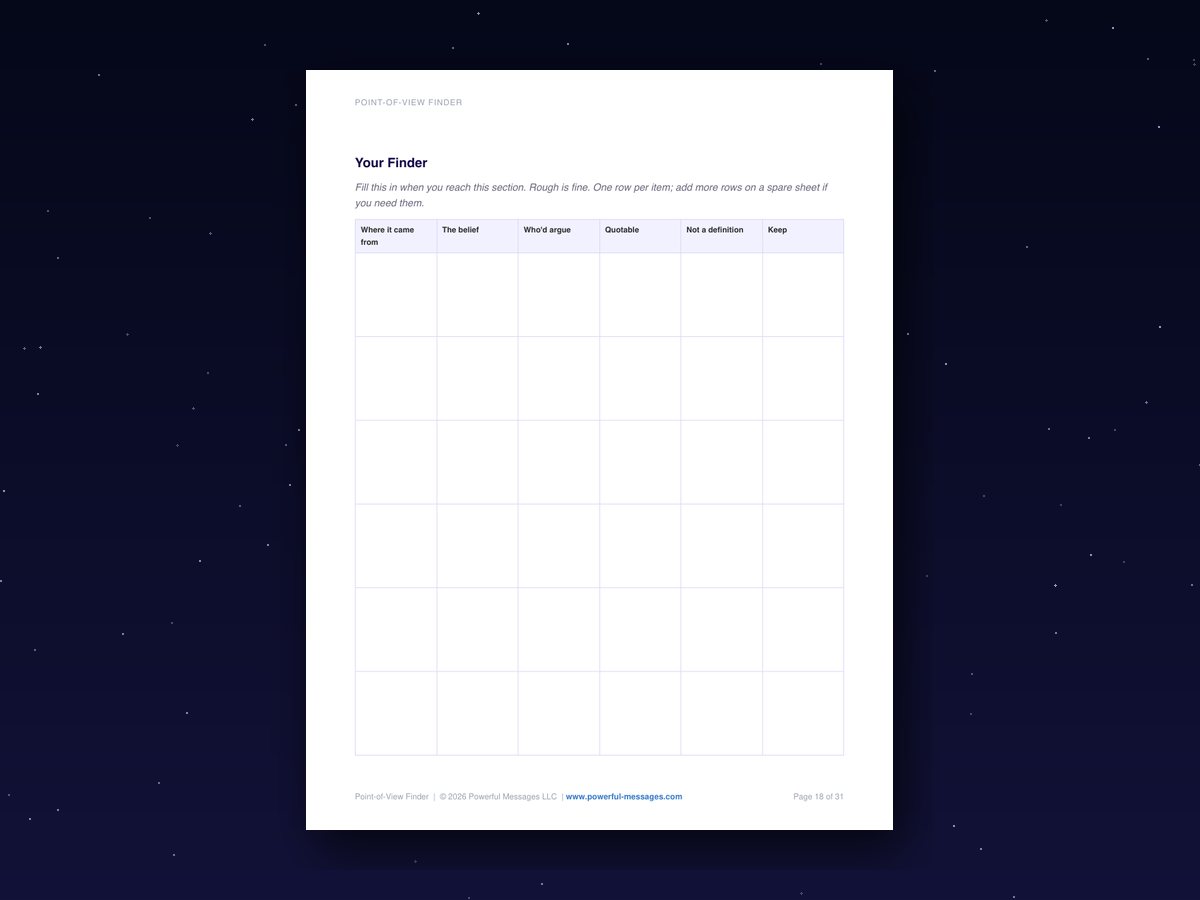
The beliefs you already carry become a sentence you'd be quoted on. A six-column table: where the belief came from, the belief in one sentence, who'd argue with it, quotable, not a definition, keep. Four starter rows pulled from what you already say.
Who you're becoming
You're not becoming an influencer. You're becoming the person somebody can describe in a sentence. One line, and it's yours.
Decide, and date it
The blank page stops being where the week stalls. Tick Keep on one row, write it plain, and put today's date next to it.
What a decided view opens
The right people finally have something to hand you. The pillar already showing in your table, and who can now describe what you do.
Check it against what you wanted
You know whether the sentence reaches the people you meant it for. Hold it next to the people you named at the start, and write one honest line about the distance.
Your own Notion copy
One click to duplicate, type straight into it, keep it forever. Nothing you write is visible to anyone but you.
Printable PDF
The same nine sections, laid out to print, with ruled space to write and a blank Finder on the last page.
Take a look inside
Press play for a quick look inside.
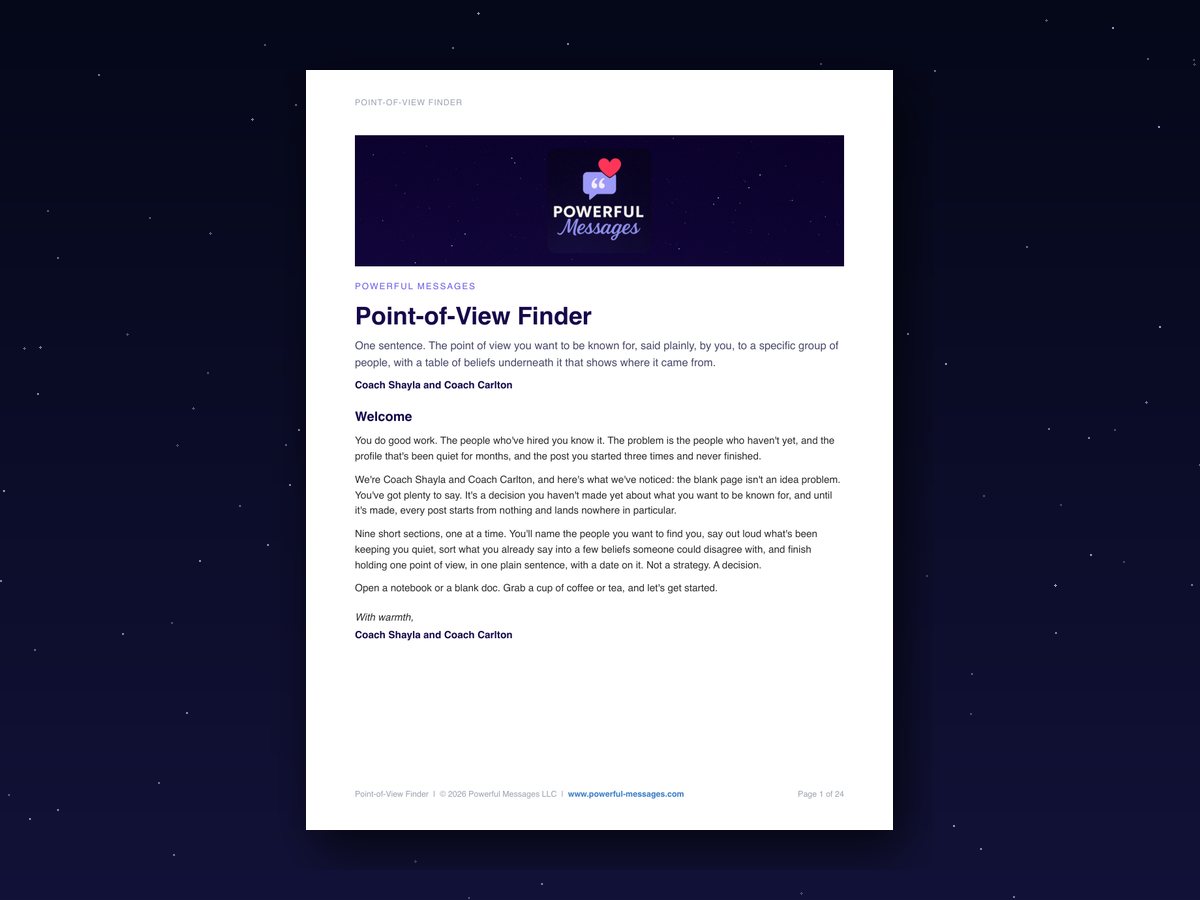
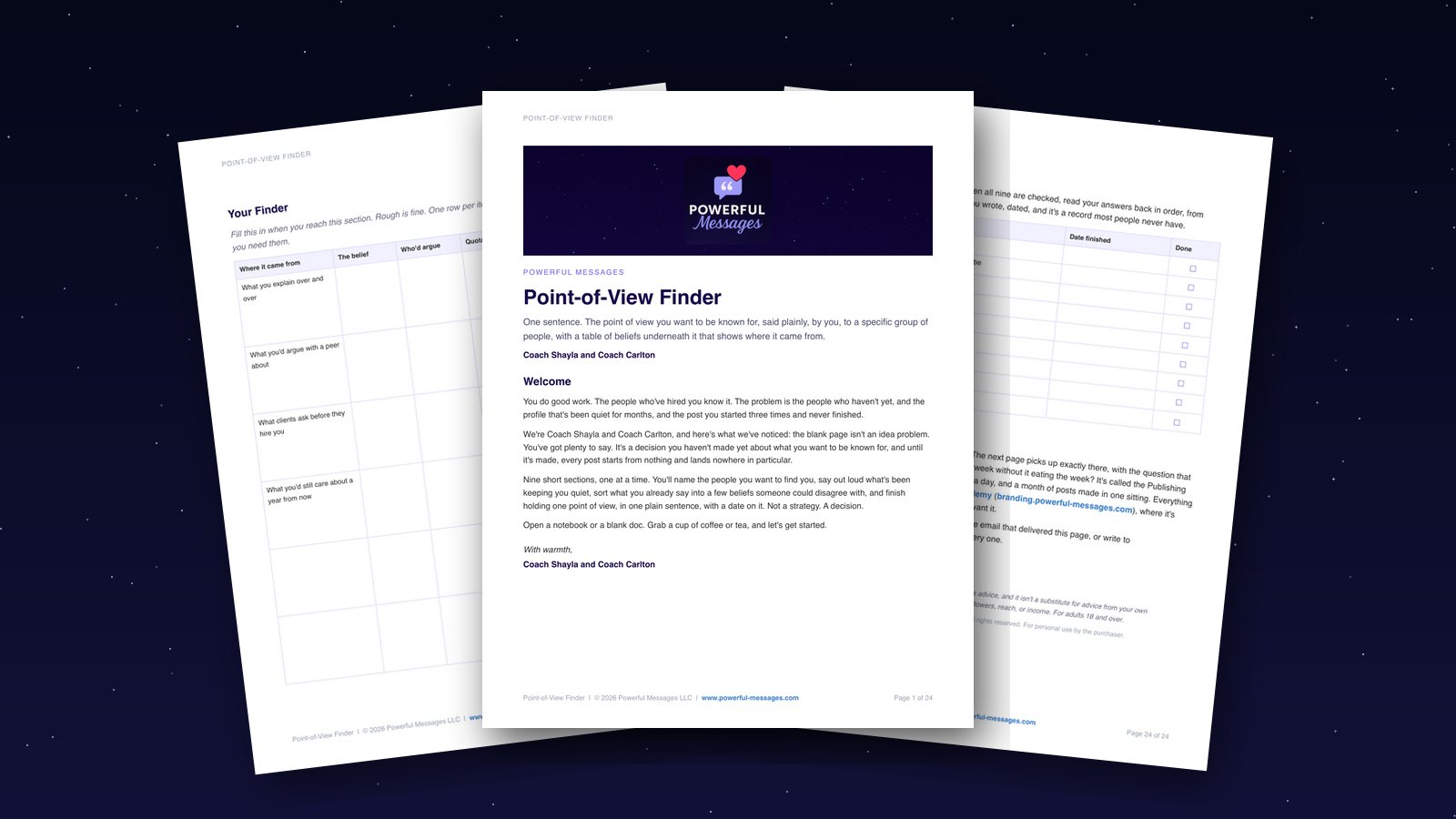
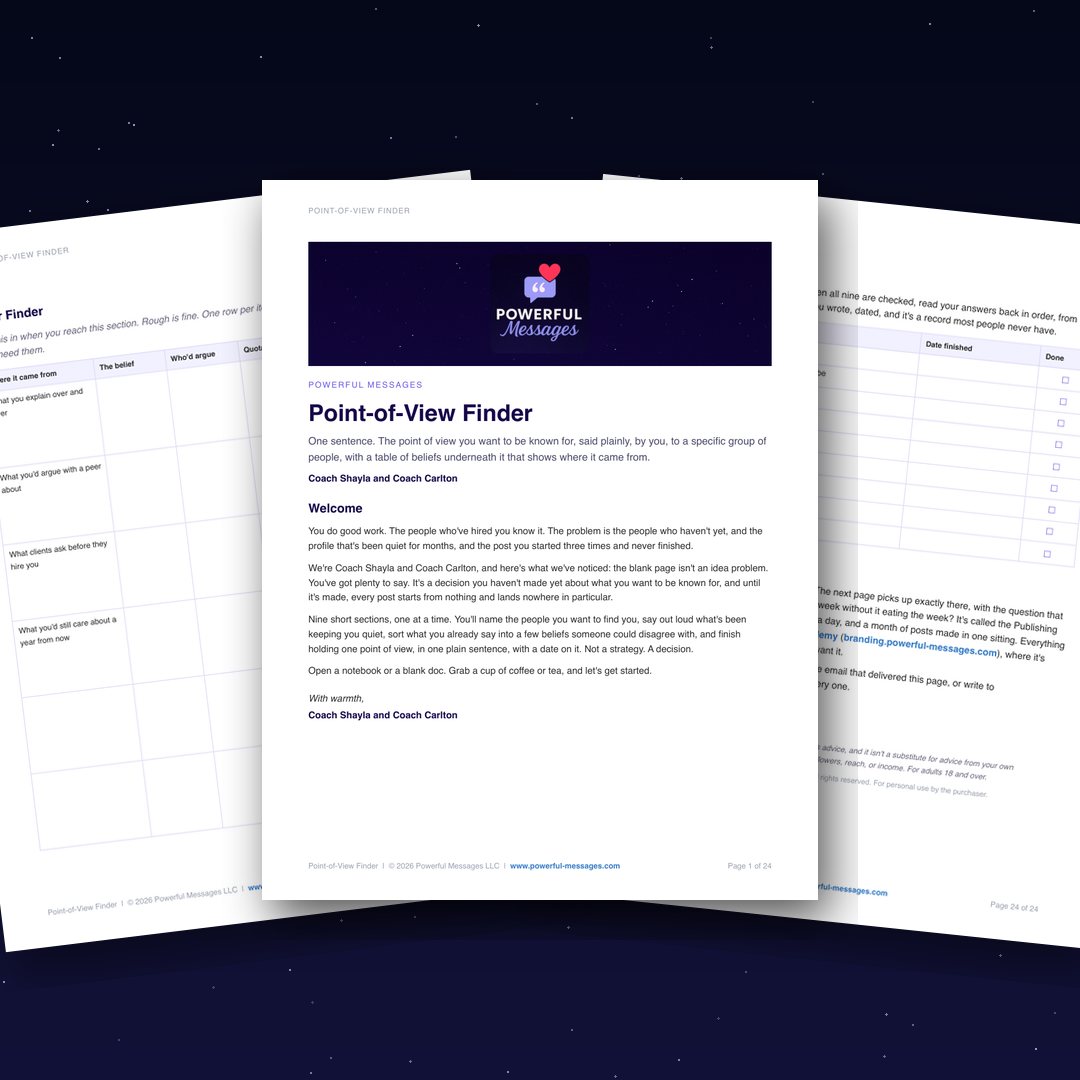
The cover, and the welcome from Coach Shayla and Coach Carlton.
The Finder table: four starter rows, six columns, one row you'll keep.
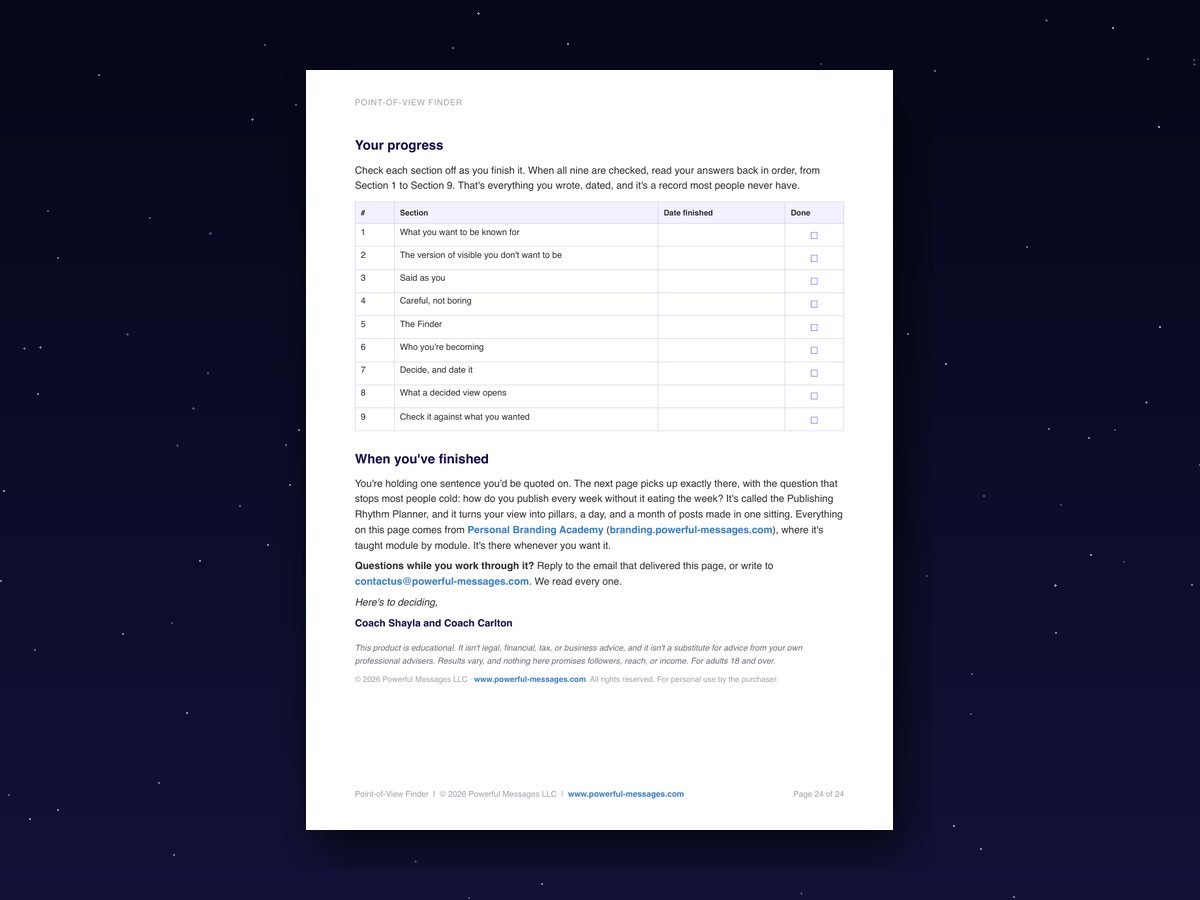
Your answers, all in one place, with a date and a Done box for each section.
Three free bonuses, so the page gets finished
If you've bought a guide like this before and never got past page two, these are for that. Each one is a page you keep next to the Point-of-View Finder. They come in the same email, a minute or two after you order.
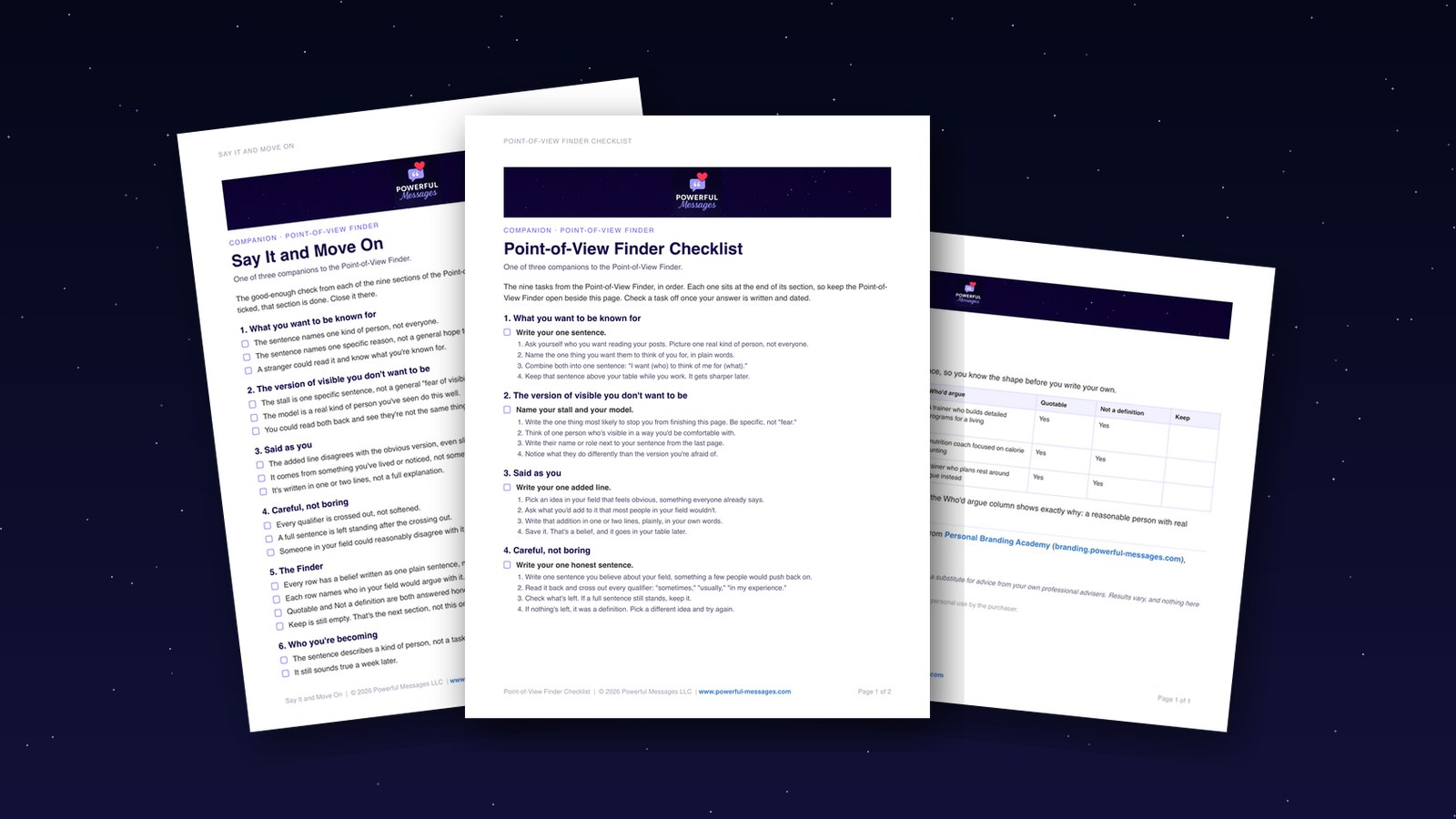
Point-of-View Finder Checklist
The nine tasks from the Point-of-View Finder, one per section, in order. Tick each one off once your answer is written and dated, so you always know where you stopped.
Filled Point-of-View Finder
The Finder from Section 5, filled in by the coaches. Read it once so you know the shape before you write your own.
Say It and Move On
A good-enough check for each of the nine sections. When every box is ticked, that section is done, and you can close it without a second edit.

What changes once the sentence is written down
- Every post starts from a sentence you already decided, so the blank page stops being where the week stalls.
- You've named the version of visible you won't become, so the flinch stops making the decision for you.
- You know how small an audience can be and still count, so you stop measuring yourself against accounts you don't want to be.
- Somebody who knows you can describe what you do in one sentence, so the right people finally have something to hand you.
This was built for you if…
- You do good work and your profile looks abandoned, and you notice it every time somebody looks you up.
- You've got plenty to say and you've never decided what you want to be known for.
- You don't want to be an influencer, and the versions of visibility you've seen are ones you'd rather not become.
- You've got a job or a business that comes first, and content has to fit around it.
- You'd rather decide once, in writing, than keep starting from nothing.
It isn't for you if…
- You want a content calendar or a posting schedule. That comes after this, not instead of it.
- You want a viral hook template or a platform recommendation. This tool decides what you think before it decides anything else.
- You want someone to write your point of view for you. It has to be yours, or nobody will believe it.

Meet the coaches behind it
We're Coach Shayla and Coach Carlton, the husband-and-wife team behind Powerful Messages. After decades in Fortune 500 corporate America, we know what it's like to be handed something new and unclear with your name on it. Coach Shayla and Coach Carlton each bring more than 20 years in their fields, People Analytics and enterprise sales, and a practical way of building things that hold. We built the Point-of-View Finder because we've watched capable people post for two weeks, go quiet for three, and blame their discipline, when the real gap was a decision nobody told them to make first.
Two options from here.
Keep restarting: two weeks of posts, three weeks of quiet, and a blank page every time, because nothing was decided.
Or decide once, with what you already believe: who you want to find you, what for, and the one thing some people in your field would argue with. One sitting. One sentence, dated. Every post after this starts from there.
Decide it once. Every post after this starts from there.
One payment. Yours to keep.
Get the Point-of-View Finder for $27$37 on its own · you save $10Get the Point-of-View Finder for $27
Your name, your email, and your card. Your links arrive by email a minute or two after you pay.
Everything you get today
- Point-of-View Finder the one sentence every post starts from, decided and dated (Notion page plus printable PDF)$37
- Free bonus: Point-of-View Finder Checklist the nine tasks, one per section, to tick off as you go$19
- Free bonus: Filled Point-of-View Finder the coaches' worked example, so you know the shape before you write yours$27
- Free bonus: Say It and Move On when to call each section done and stop editing$19
| Total value | |
| Today | $27 |
One payment, no subscription. Instant access after payment.
I agree to the Terms and Privacy Policy, and to calls and texts about my order. Msg and data rates may apply. Reply STOP to opt out.
Questions people ask
I've bought things like this before and never finished them.
Most of them ask you to read. This one asks you to write one thing per section, and each section ends with a Done box. The Point-of-View Finder Checklist keeps your place and the Say It and Move On tell you when to stop. If it still isn't for you, the guarantee covers seven days.
Is one sitting enough?
About two hours, and most sections take ten to fifteen minutes. If you need to stop, stop after the Finder and come back tomorrow. Everything you've written stays where you left it.
I'm not a writer. Will I be able to do this?
You're not writing posts here. You're writing one sentence you already believe, and the test is crossing out the qualifiers to see what's left. If you've ever explained something to a client, you've already done the hard part.
Do I need Notion?
No. The free plan works, and one click duplicates the page into your own workspace. If you'd rather not use Notion at all, the PDF has the same nine sections with space to write.
What if I don't want to be "one of those people"?
Good. Section 2 is built for that flinch. You'll name the version of visible you don't want to become and pick one person who's visible in a way you'd respect. The flinch usually means you have standards, not that you should stay quiet.
What's the PDF for?
The same nine sections laid out for paper, with ruled space to write and a blank Finder on the last page. Some people think better with a pen. Print it, or keep it on your phone.
How long do I have access?
It's yours to keep. The Notion page copies into your own workspace, and the PDF is a file you download. Nothing expires.
Can I get a refund?
Yes. Work through it, and if it isn't for you, email us within seven days for a full refund.
What happens after I buy?
An email arrives from Powerful Messages with your links. Click Duplicate on the Notion page, or open the PDF, and start at section one. The email also tells you where to write if a question comes up.

Next Tuesday, picture the draft already open
You sit down to write. Above the blank box is a sentence you decided last weekend: who you want reading this, what you want them to think of you for, and the one thing you believe that some people in your field would argue with. You're not inventing a post. You're saying the next true thing about a view you've already chosen.
Same job. Same week. Same people who've hired you. The difference is that the people who haven't yet can finally tell, from one look, what you're the one to ask about.
The decision is made. The next post starts from it.
One sitting. One sentence, dated. Every post after this starts from there.