
Write the one sentence every bio, proposal, and page gets written from.
One payment. Instant access. A Notion page you copy plus a printable PDF.
From two coaches with more than 20 years each in People Analytics and enterprise sales.
Plus three free bonuses, included with your order.Scroll down to see them
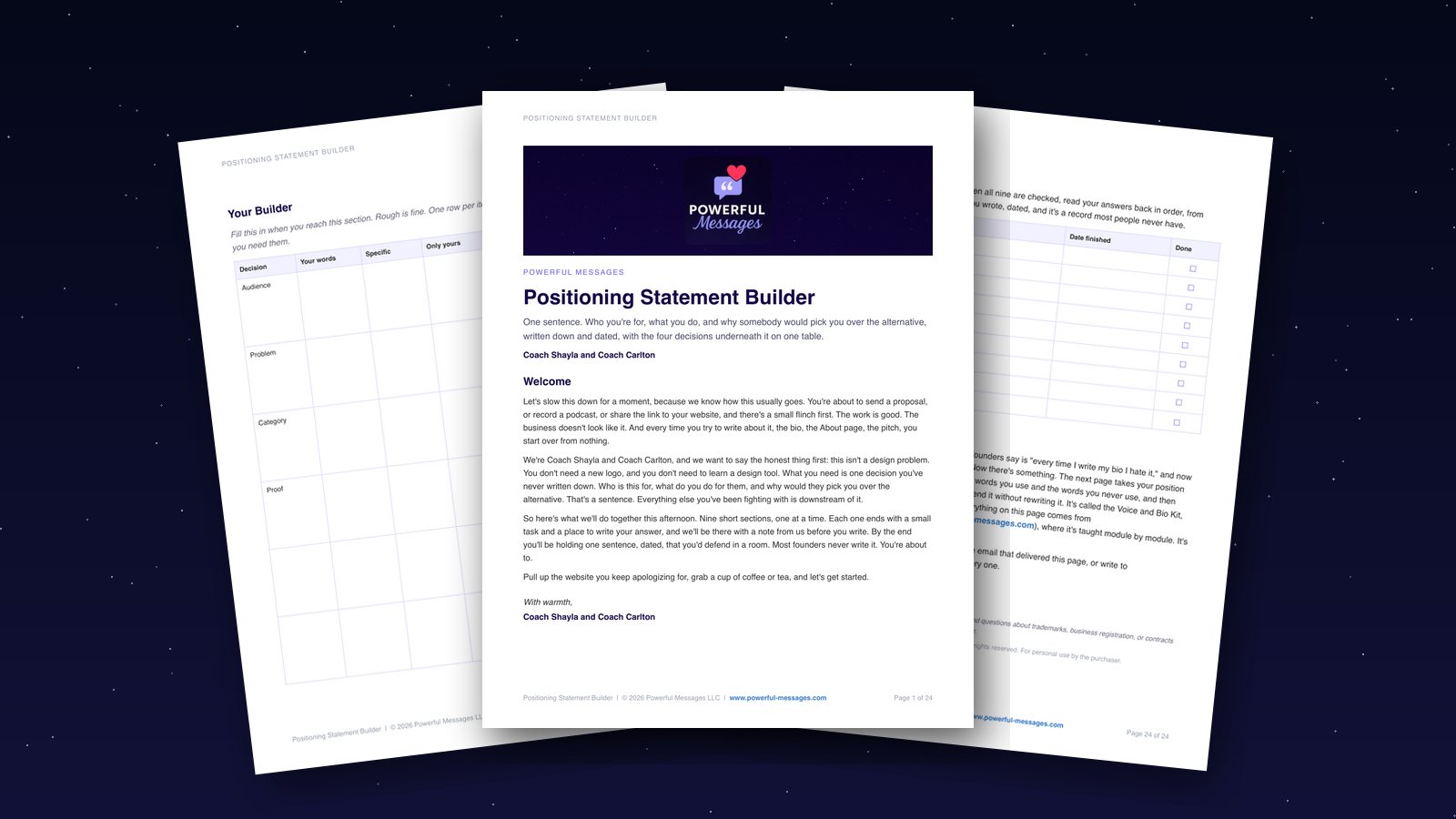
By the end of one afternoon you're holding the sentence everything else gets written from: who you're for, what you do, and why somebody would pick you over the alternative, dated, with the four decisions under it on one table. Nine short sections get you there, one thing to write in each, about two hours in all.
You already know the logo didn't fix it.
You're about to send a proposal. Or the link to your website. Or the bio a podcast host asked for on Tuesday. And there's a small flinch first. The work is good. The business doesn't look like it.
So the plan becomes a redesign. A lot of founders have already paid for one. They opened the logo file, felt good for a day, and noticed that nothing about how the business reads had changed.
Maybe you asked ChatGPT for a positioning statement and got something with "empower" in it that could belong to any company alive. Maybe a branding agency sent a deck, and the deck was beautiful and the sentence on page three was still vague. Neither one knows who you'd send to a competitor, so neither one can write the line that says who you're for.
We're Coach Shayla and Coach Carlton, and we've watched this happen often enough to say it plainly. This isn't a design problem, it's a decision problem. You bought the last layer first, so there was nothing underneath to hold it up.
The layer underneath is one sentence. Who you're for, what you do for them, and why they'd pick you over the alternative. Most founders have never written it down. Not because they can't. Because narrowing feels like losing money, so you've been calling the vague version "keeping our options open." Vague doesn't keep options open. It makes you invisible to everybody at once.
Once that sentence exists, the bio stops being a fresh argument with yourself. The About page has a first line. A contractor can be briefed in a paragraph. The Positioning Statement Builder exists so you can write that sentence this afternoon, with us beside you, for $27.

Does this sound like your week?
- You paste the website link into a message to a prospect and type "ignore the site, it's old" before you hit send.
- A podcast host asks for your bio. You open a blank document instead of the last one you sent, because that one was wrong too.
- Your proposal, your LinkedIn profile, and your homepage are open in three tabs, and they read like three different companies.
- You paid a few hundred dollars for a logo, opened the file, and nothing about how the business reads changed.
- You softened "founders" to "business owners" to "anyone" in your own description, because picking one felt like turning money away.
The problem isn't that you haven't tried. It's that every fix you've bought sat on top: a logo, a palette, a template, with nothing underneath them to hold them up.
So it's tempting to plan one more redesign. But a new site doesn't make the decision for you. A year from now you could have a better logo, a fresh homepage, and a folder of bios, and the proposal would still open with a flinch, because the sentence underneath it was never written.
You don't need a new logo, a new website, or a designer.
You need one decision, written down, that everything else can be written from.
One sentence, dated, with the four decisions under it
Before you pay for another logo, redo the site, or draft the bio one more time, make the decision underneath them, so every proposal, bio, and page after this gets written from something instead of argued from scratch.
By the end of the afternoon you're holding a positioning statement you'd defend in a room. Not a tagline. A plain sentence that says who you're for, what you do, and why you over the alternative, dated, with a ninety-day promise to leave it alone and let real use tell you what to change.
Under it sits the Builder table: the four decisions the sentence forces (audience, problem, category, proof), your words for each, and two tests per row. Would a stranger guess who you'd turn away. Could a rival put their name on it unchanged.
It isn't a logo, a palette, or a design tool. It's the decision the logo was supposed to be built on. Every proposal, bio, and page after this gets written from it instead of argued from scratch.
It also costs nothing to change your mind about later. No designer to re-brief, no site to rebuild, no money spent on a layer that sits on top. It's one sentence and a table, which is why you can write it this afternoon and put it to work this week.
Here's how the Positioning Statement Builder works
Buy it, open the email
Two links: one opens the Notion page, one downloads the PDF.
Make it yours
Click the Duplicate icon and the page copies into your own Notion. All you need is a free Notion account. You don't need a paid plan. Or print the PDF. Same sections, ruled space to write.
Work through nine short sections
Tuesday at two, door closed, Section 1 open: one line about what a customer should say about you when you're not in the room, and the first one is done. Each one ends with one thing to write. Most take ten to fifteen minutes; the Builder takes about twenty. Stop after the Builder if you need to and come back tomorrow.
Finish holding the sentence
Plus the Builder table under it, and the list of every place a customer meets your business.
Notice, along the way:
- By Section 3, the logo is back in its drawer and the list of who you're really up against has "doing nothing" on it.
- By Section 5, the four decisions are in one table in your words, and the two tests have already caught the vague version.
- By Section 9, you can read your own homepage as a stranger and say in one line which surfaces have caught up.
Everything inside the Positioning Statement Builder
Not a folder of information. Nine short sections, one thing to write at the end of each, and a note from us before you write.
What you want to be known for
You decide what the sentence is for before you write it. What a customer should say about you when you're not in the room, and every place a customer meets the business right now.
The narrowing fear
"No" stops feeling like lost money. Why you keep widening the sentence, the customer you'd happily send to a competitor, and why nobody stops a good-fit client at the door.
A decision, not a design
Your time goes to the layer that decides how the business reads. Leave the logo alone this month, and list who you're up against for real, doing nothing included.
The story under the hedge
The business stops hiding the person who runs it. Why the site says "we" when it's you at the desk, and how much of you belongs in the sentence.
The Builder
The sentence gets written, in a shape a rival couldn't put their name on. The four decisions it forces, the four ways founders get it wrong, and the fill-in table.
Who you're becoming
You're not becoming a brand. You're becoming the founder who has this written down. One honest line, and it's yours.
Pick one and date it
The bio stops being a fresh argument with yourself. Choose the version you'd defend today, date it, and paste it into one real place this week.
What a written position opens
Other people can write as the business without you. The pitch that finishes itself and the contractor briefed in a paragraph.
The stranger test
You know which surfaces still say the old thing. Read your homepage as a stranger, time how long it takes to know who it's for, and mark which ones have caught up.
Your own Notion copy
One click to duplicate, type straight into it, keep it forever. Every answer collects on one table, dated.
Printable PDF
The same nine sections laid out to print, the Builder as a fill-in page, and a progress list at the end.
Take a look inside
Press play for a quick look inside.
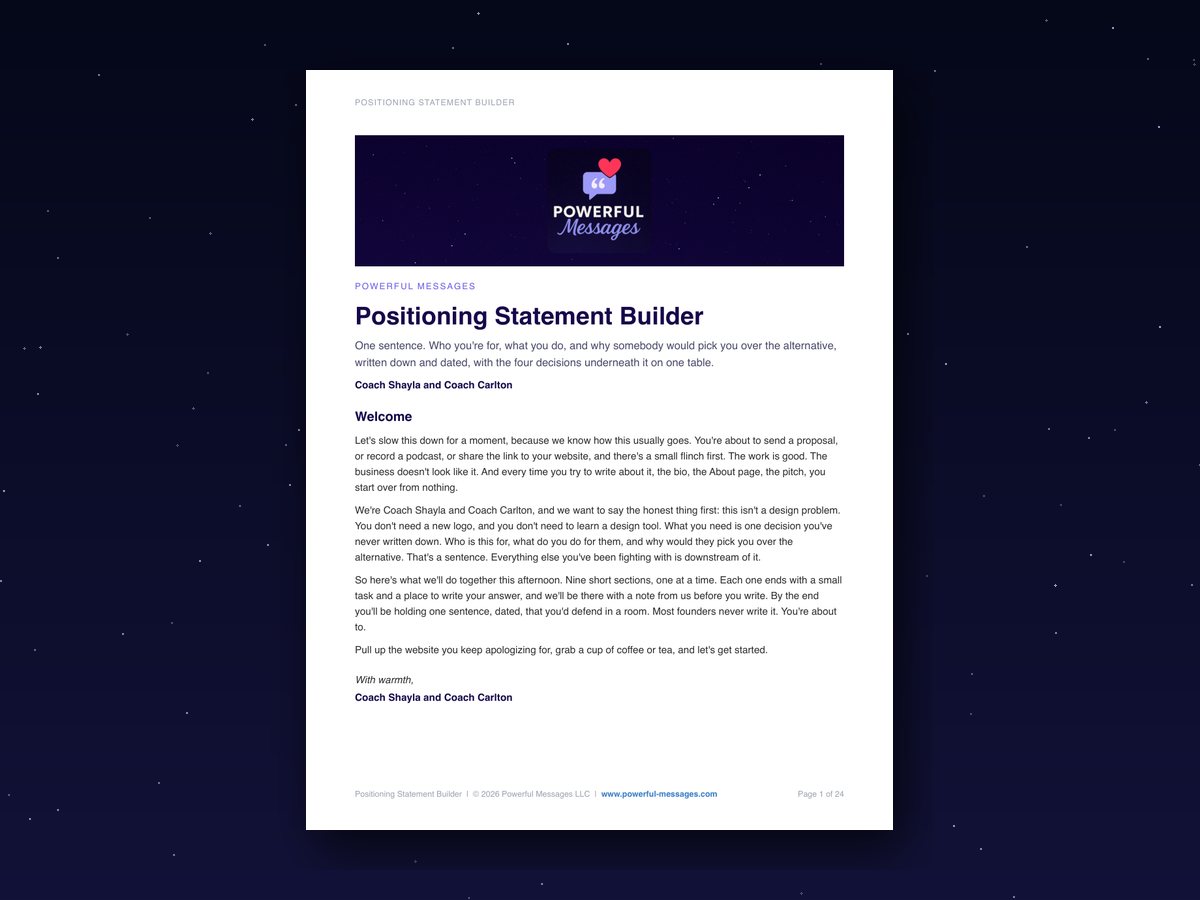
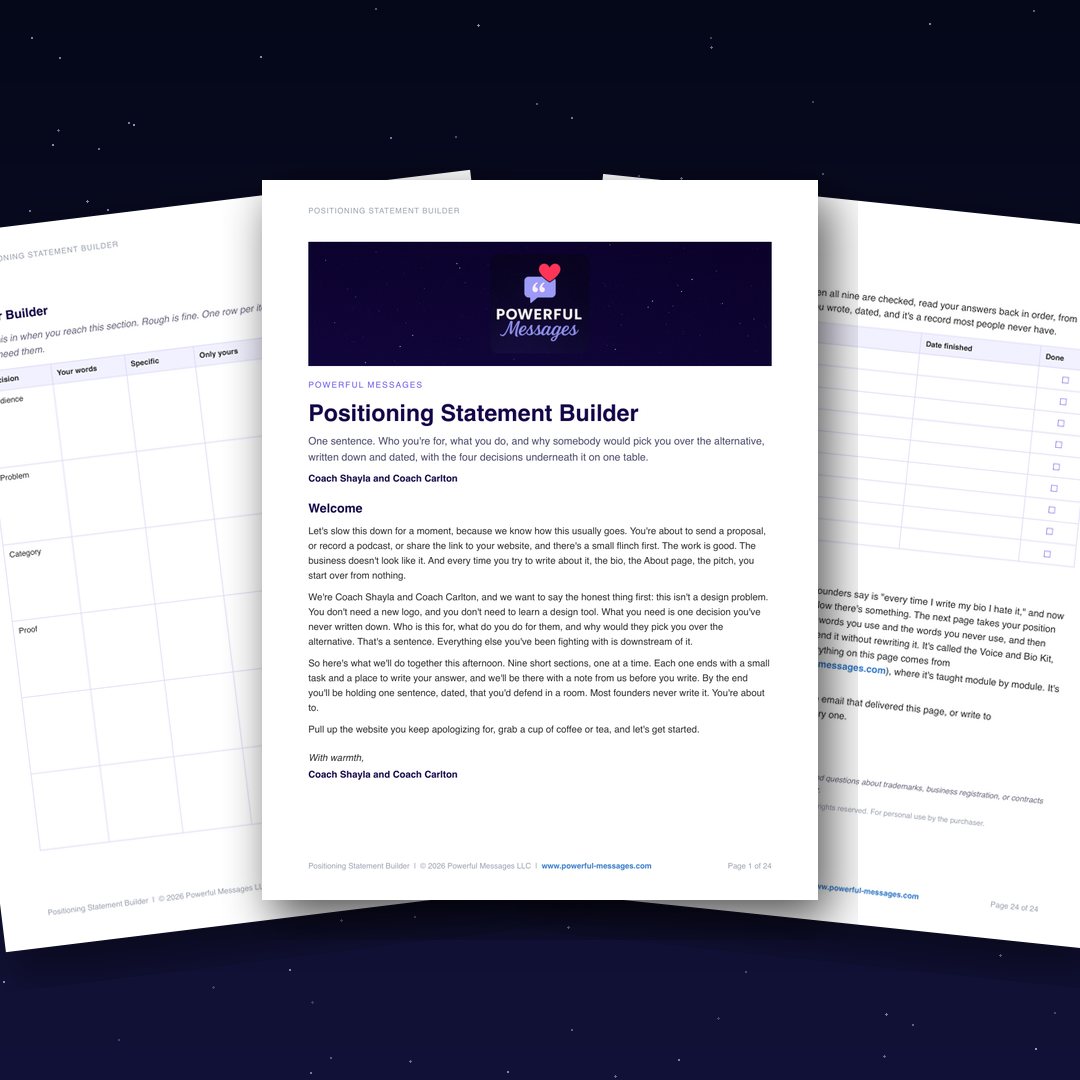
The cover. Thirty-one pages, printed or on screen.
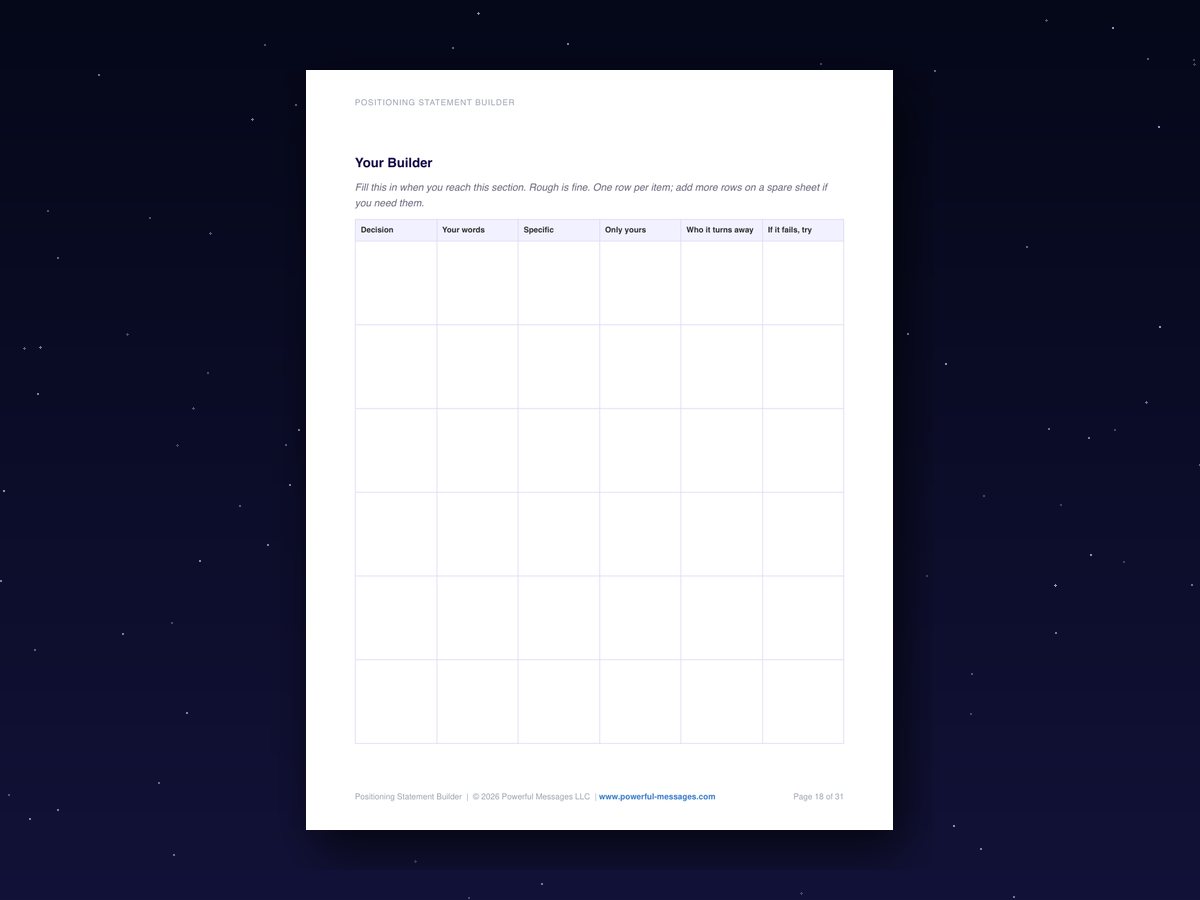
Your Builder. Four decisions, your words, and the two tests each one has to pass.
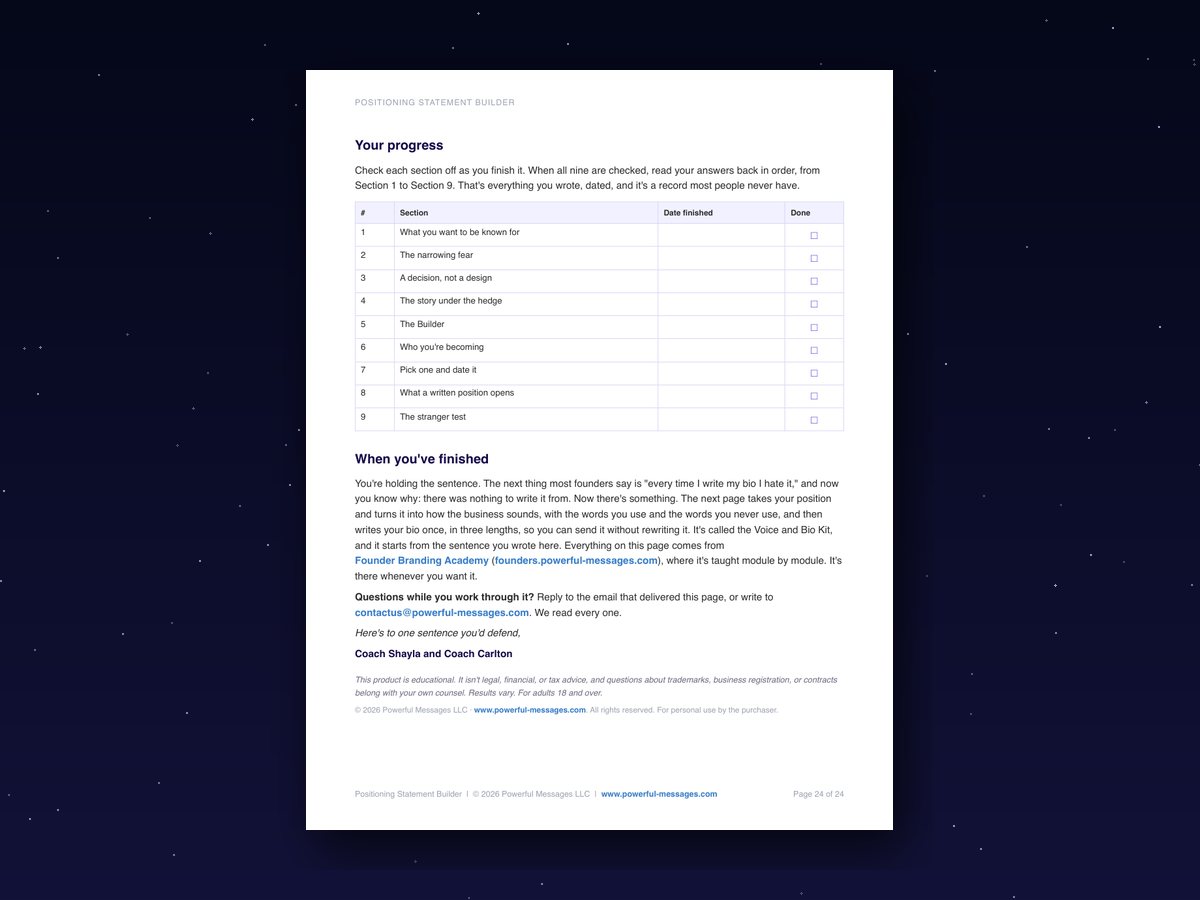
Your progress. Nine sections, a date next to each, and the sign-off from us.
Three free bonuses, so the page gets finished
If you've bought a guide like this before and never got past page two, these are for that. Each one is a page you keep next to the Positioning Statement Builder. They come in the same email, a minute or two after you order.
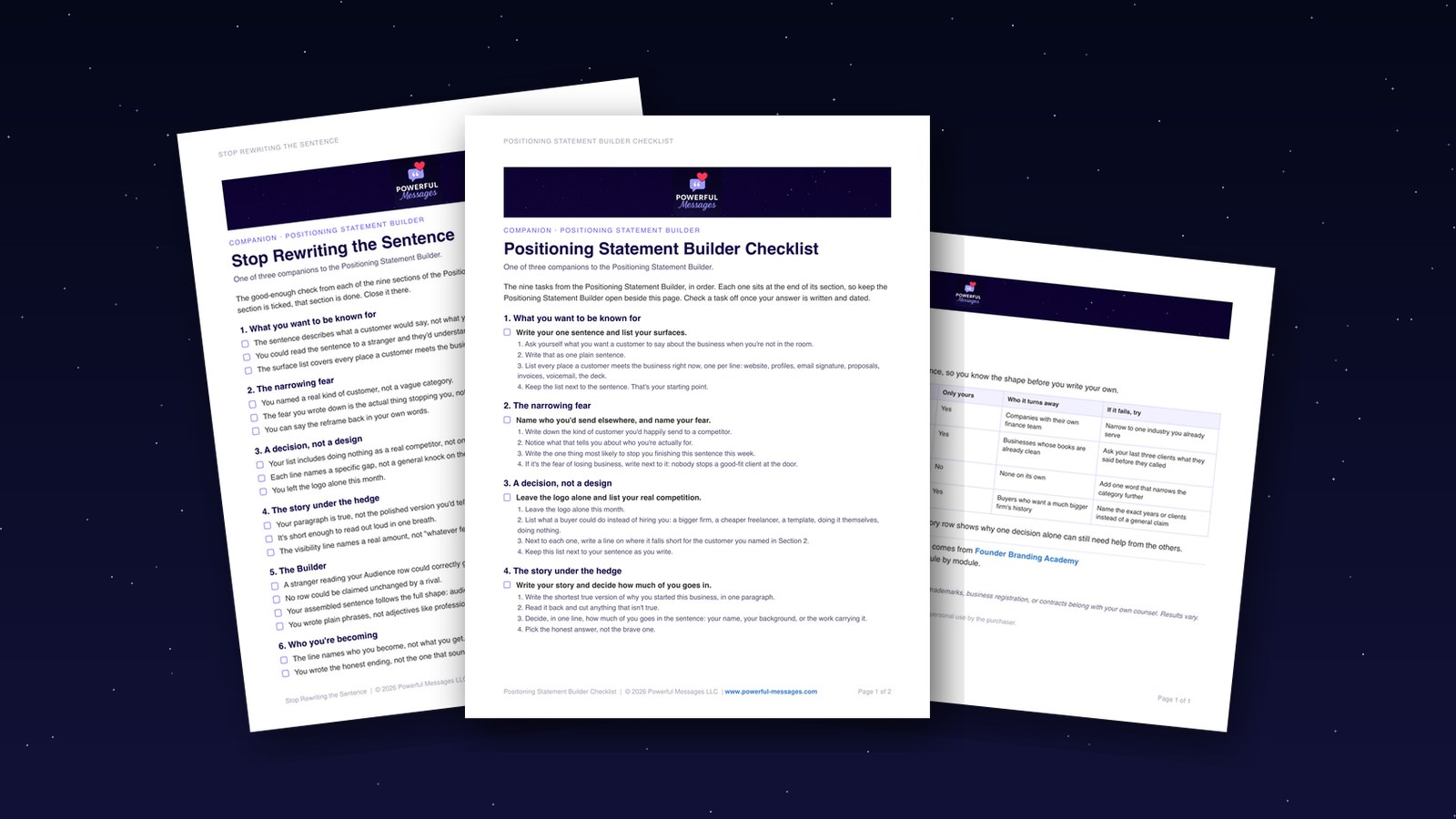
Positioning Statement Builder Checklist
The nine tasks from the Positioning Statement Builder, one per section, in order. Tick each one off once your answer is written and dated, so you always know where you stopped.
Filled Builder
The Builder from Section 5, filled in by the coaches. Read it once so you know the shape before you write your own.
Stop Rewriting the Sentence
A good-enough check for each of the nine sections. When every box is ticked, that section is done, and you can close it without a second edit.

What changes when it's written down
- Your proposal opens with the position, so that a buyer knows who it's for before they reach the price.
- You've named who you'd send elsewhere, so that "no" stops feeling like lost money.
- A contractor or a new hire gets one paragraph, so that they can write as the business without a long call first.
- You've got a list of every place a customer meets you, so that you can bring them into line one at a time.
This was built for you if...
- You run a business with real customers, and your bio, website, and pitch sound like three different companies.
- You've paid for a logo or a palette, or made one yourself, and it didn't change how the business reads.
- You've never written down who you're for and who you'd send elsewhere, and every piece of copy wobbles because of it.
- You're bringing on a contractor or a hire and discovering the brand only ever lived in your head.
- You'd rather spend one afternoon deciding than another month on a redesign that explains nothing.
It isn't for you if...
- You want a logo, a color palette, or a tool recommendation. The Builder is words, on purpose.
- You want someone to write the sentence for you. The decision is the product, and you make it.
- You're looking for press, investors, or growth promises. A written position makes you clear, not famous.

Meet the coaches behind it
We're Coach Shayla and Coach Carlton, the husband-and-wife team behind Powerful Messages. After decades in Fortune 500 corporate America, we know what it's like to be handed something new and unclear with your name on it. Coach Shayla and Coach Carlton each bring more than 20 years in their fields, People Analytics and enterprise sales, and a practical way of building things that hold. We built the Positioning Statement Builder because so many of the founders we've met who were unhappy with their brand had bought the last layer first, and nobody had asked them to write the first one down.
Two options from here.
Keep arguing the bio from scratch every time someone asks, and keep typing "ignore the site, it's old" before you hit send.
Or make the decision once, with what you already know: who you're for, who you'd send elsewhere, and why you over the alternative. One afternoon. One sentence you'd defend. Everything else written from it.
One afternoon. One sentence you'd defend. Everything else written from it.
One payment. Yours to keep.
Get the Positioning Statement Builder for $27$37 on its own · you save $10Get the Positioning Statement Builder for $27
Your name, your email, and your card. Your links arrive by email a minute or two after you pay.
Everything you get today
- Positioning Statement Builder the one sentence every bio, proposal, and page gets written from (Notion page plus printable PDF)$37
- Free bonus: Positioning Statement Builder Checklist the nine tasks, one per section, to tick off as you go$19
- Free bonus: Filled Builder the coaches' worked example, so you know the shape before you write yours$27
- Free bonus: Stop Rewriting the Sentence when to call each section done and stop editing$19
| Total value | |
| Today | $27 |
One payment, no subscription. Instant access after payment.
I agree to the Terms and Privacy Policy, and to calls and texts about my order. Msg and data rates may apply. Reply STOP to opt out.
Questions people ask
I've bought things like this before and never finished them.
Most of them ask you to read. This one asks you to write one thing per section, and each section ends with a Done box. The Positioning Statement Builder Checklist keeps your place and the Stop Rewriting the Sentence tell you when to stop. If it still isn't for you, the guarantee covers seven days.
Is one afternoon enough?
For the sentence, yes. Nine sections, about two hours in all. There's a natural break after the Builder, and everything you've written is still there tomorrow.
I'm not a writer. Will I get stuck?
You're not writing prose. You're making four decisions and putting them in one shape. Every section ends with a row that names exactly what to write, and we leave a note before each one so nobody types into a blank box.
Won't narrowing lose me business?
Narrowing changes what you lead with, not who you'll accept. A client who doesn't match your sentence can still call, and you can still say yes. What changes is that the client who does match can finally tell you're talking to them.
What if I keep changing my mind about the position?
Section 7 asks you to pick the version you'd defend today, date it, and use it for ninety days. It stops feeling uncertain when a customer repeats it back to you, not when you edit it one more time.
Do I need Notion?
No. Notion's free plan is enough if you want the live version, where every answer collects on one table. If you'd rather not, the PDF has the same nine sections with ruled space to write.
What's the PDF for?
Paper. Some founders think better with a pen, and the Builder table is easier to scribble on than to type into.
How long do I have access?
It's yours to keep. The Notion page copies into your own workspace, and the PDF is a file you download. Nothing expires.
Can I get a refund?
Yes. Work through it, and if it isn't for you, email us within seven days for a full refund.
What happens after I buy?
An email from Powerful Messages arrives with two links: one to the Notion page and one to the PDF. Click Duplicate, start at Section 1, and write one thing per section.
Next Tuesday, a prospect asks for the link.
You send it. No "ignore the site, it's old" first. The top of your proposal says who it's for before it says what it costs. A podcast host asks for a bio and you paste the one you already have.
Same business. Same customers. Same logo, for now. The difference is one dated sentence, written in an afternoon, that everything else is finally being written from.
The layer underneath exists now.
One afternoon. One sentence, dated. Everything else gets written from it.